
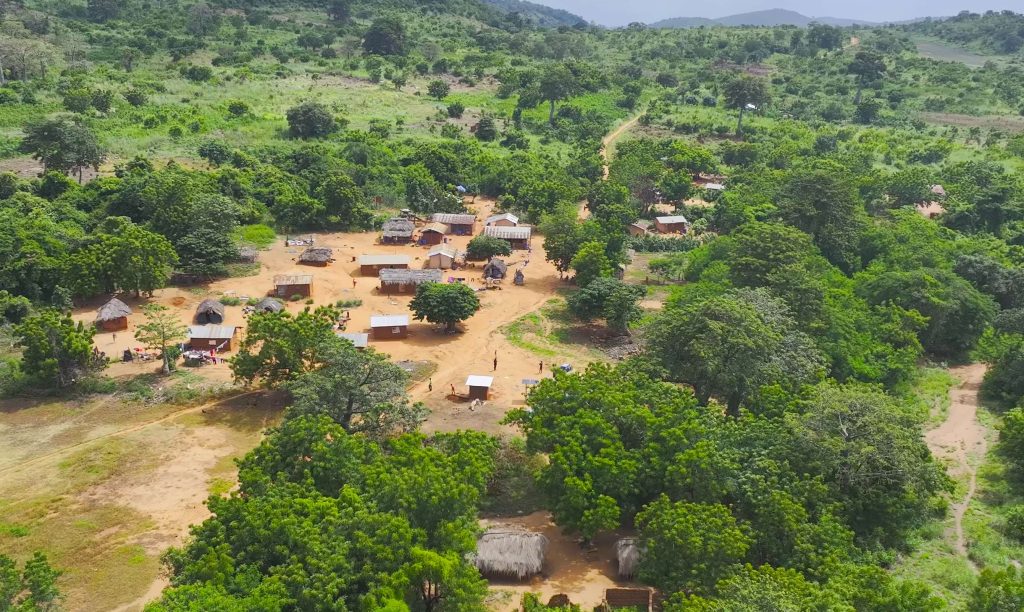
350 Ghana Reducing Our Carbon, 350GROC, is set to bring clean and decentralized electricity to 36 households in Apaaso in the Asuogyaman District of Ghana’s Eastern Region through a community solar micro-grid. Apaaso, more than six decades ago, became part of
Ghana’s history as one of the communities established to accommodate people displaced by the construction of the Akosombo Dam on the Volta River.
The project represents a practical example of how renewable energy can be deployed at community level to improve access to electricity while supporting Ghana’s transition towards a cleaner and more sustainable energy system.
The Apaaso project is built around a 4.92 kilowatt-peak off-grid solar photovoltaic system designed to generate electricity for the participating households.
The system comprises eight 615-watt bifacial solar panels, which will convert sunlight into electricity during the day. With an expected average of about five peak sun hours daily and an estimated system efficiency of 90 percent, the installation is projected to generate approximately 20 to 22 kilowatt-hours of electricity per day.
Electricity generated during the day will also be stored in batteries for use when sunlight is unavailable.
The micro-grid includes two 5 kilowatt-hour BYD lithium iron phosphate batteries, providing 10 kilowatt-hours of total storage, with approximately 8 kilowatt-hours expected to be usable. An 8 kVA Victron MultiPlus-II inverter will convert and manage the stored electricity for household use through a 230-volt AC distribution system.
The project has been deliberately designed around the actual energy needs of the participating households.
The initial system will support essential household electricity needs such as lighting, mobile-phone charging, small fans and radios. Each household will have a 15-watt LED bulb, while an additional 30-watt light will serve a shared need.
The design also recognises that a small community solar system cannot immediately provide unlimited electricity.
High-consumption appliances such as refrigerators, electric irons, heating coils and water pumps are outside the current system’s intended capacity. Fan use will also be managed to ensure that available electricity and battery storage are used responsibly.
This approach places energy management at the centre of the project.
Rather than simply installing solar panels and expecting them to meet every possible electricity demand, the Apaaso model demonstrates the importance of matching electricity generation and storage capacity with community demand.
For 350GROC, the project is also about more than providing electricity.
The organisation has positioned decentralized renewable energy as an important part of Ghana’s sustainable energy future. Its work includes renewable energy projects focused on communities, schools, women and young people.
Ghana is also increasingly looking to decentralized renewable energy solutions as part of efforts to expand electricity access. The Energy Commission regulates and manages the development and utilisation of energy resources, including renewable energy, while national energy programmes have included renewable-energy-based mini-grids for communities that can be difficult or expensive to connect to conventional electricity infrastructure.
The Apaaso project therefore provides an opportunity to demonstrate what community-scale renewable energy can look like in practice.
It can also provide lessons for future expansion.
As electricity access grows, communities can potentially use additional renewable generation and storage capacity for productive activities such as refrigeration, water pumping, agro-processing, digital services and small businesses.
However, those opportunities will require additional generation and battery capacity beyond the present system.
The long-term success of the project will therefore depend not only on the solar equipment but also on community participation, responsible energy use, maintenance, technical support and clear arrangements for managing the system.
Apaaso’s experience could ultimately contribute to a wider conversation about how Ghana can build an energy transition that puts communities and people at the centre.
For the 36 households, however, the immediate significance is much simpler.
The sun that has always been part of everyday life in Apaaso will now become a source of electricity, lighting homes and creating new possibilities through a locally focused renewable-energy system.
The project demonstrates that Ghana’s clean-energy transition does not have to be measured only in megawatts and large power plants.
It can also be measured in homes that receive reliable lighting, children who can study after dark, families able to charge their phones, and communities gaining practical experience with clean energy.For Apaaso, the transition begins with 36 households an

